INVESTIGATION: Inside the Sahel's Gold Smuggling Network Fueling Terror and Violence
INVESTIGATION: Inside the Sahel's Gold Smuggling Network Fueling Terror and Violence
By Divine Macaulay ·
This investigation was supported by the Pulitzer Center.
In Maru, a local government area in Zamfara State, gold mining is not merely an occupation — it is a way of life.
From dawn, motorcycle riders shuttle between mining sites and nearby communities, their clothes coated in dust from long hours underground. Some return from overnight shifts carrying sacks of ore, while others head out with shovels and digging equipment strapped to their bikes.
"If you were born here, you would most likely become a gold miner," one local miner told The Liberalist.
Interviews with dozens of residents revealed how deeply gold mining is woven into the fabric of daily life in Maru. Among them is 45-year-old Aliyu Suleiman, who has spent 35 years mining gold, and Shamsudeen Ibrahim, 32, who has worked in the mines for over a decade.
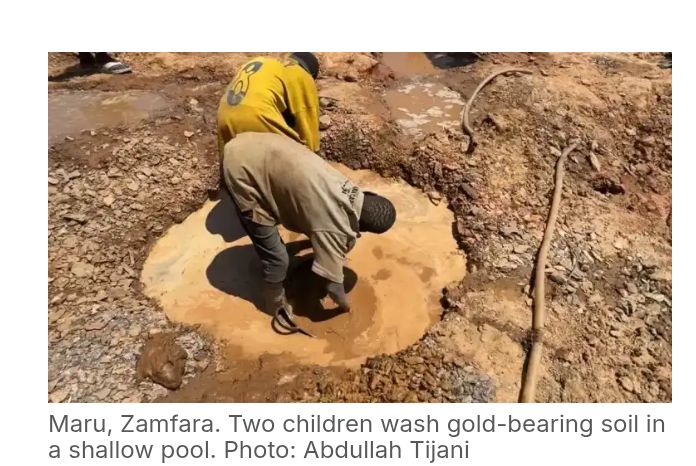
The culture of mining is so entrenched that after rainfall, residents gather around stagnant pools to wash soil in search of gold particles. Children imitate the process while playing, growing up with the understanding that the land beneath them holds valuable deposits.
"Anyone without a source of income knows that if he goes mining, he can feed his family," Aliyu said. "God has blessed Maru with gold. It is left for you to go out and find it."
Yet, despite the abundance of mineral wealth, many miners say they cannot freely access mining sites because armed groups have seized control of large swathes of the region.
Residents recounted how attacks linked to rival terrorist groups fighting over mining territories in Gobirawa Chali, Damaga, and Lugga communities left at least 28 people dead last year, including 20 miners.
"There are places occupied by terrorists where they carry out mining activities themselves," Aliyu said. "This business involves everyone you can imagine."
Under Nigeria's Minerals and Mining Act, ownership and control of all mineral resources rest exclusively with the Federal Government. Extracting or processing minerals without a licence issued by the Ministry of Solid Minerals Development is illegal.
However, many artisanal miners in Zamfara operate outside the formal system. In areas controlled by armed groups, illegally mined gold is traded through a thriving black market beyond government oversight.
Interviews with miners, traders and local residents familiar with the illicit gold trade revealed that gold extracted from terrorist-controlled sites in Maru and Anka often passes through a network of middlemen before arriving at a major trading hub in Gusau.
According to multiple sources, the Polo Market in Gusau serves as a critical transit point where raw ore is refined and prepared for onward movement.
"You will recognise the market by the shops selling mining equipment," Aliyu explained. "That is where people go to sell gold."
Acting on these accounts, The Liberalist travelled to Gusau to investigate the market at the centre of Zamfara's shadow gold economy.
Behind Polo Market's seemingly ordinary stalls lies a network of workshops where charcoal furnaces burn continuously and gold-bearing ore is refined. While many shops resemble blacksmith workshops, local miners and traders say they process gold from both legitimate artisanal operations and sites controlled by armed groups.
People familiar with the trade described Polo Market as an open secret — a place where everyone understands the nature of the business, but few discuss it openly.
"Be careful when asking questions about gold here," local broker Mustapha Salisu warned. "People in this market do not like talking about it."
Miners who have worked under terrorist control told The Liberalist that much of the gold extracted in Zamfara eventually leaves Nigeria through transnational smuggling routes stretching across the Sahel.
Saidu Modi*, who said he worked for several armed groups, recalled that notorious bandit leader Halilu Sububu treated gold not merely as a source of income but as a strategic asset.
"He was different from the others," Modi said. "For him, the gold was not just to make money."
According to Modi, Sububu stockpiled gold in hidden forest locations before travelling across borders. Upon his return, fighters often arrived with new weapons.
"They would say he had travelled," Modi recalled. "When he came back, there would be new guns and more powerful weapons."
The routes described by miners and traders extend through Niger Republic and Libya, suggesting a sophisticated network linking Nigeria's illegal gold trade to international arms markets.
Investigations by The Liberalist, combining eyewitness testimonies with geospatial analysis, identified major mining hubs in Niger's Djado and Tillabéri regions. Satellite imagery confirmed extensive artisanal and mechanised mining operations in areas frequently associated with armed activity.
Interviews with traders in Agadez indicated that Niger increasingly serves as a transit corridor rather than a major gold producer.
"Gold passes through here more than people realise," said Karim Mahamadou*, a gold merchant in Agadez. "Some comes from Niger, but much of it arrives from neighbouring countries."
According to local traders, gold moves from mining areas through Agadez and Niamey before crossing into Libya, particularly through Sabha and Qatrun, where international buyers from cities such as Benghazi, Tripoli and Dubai operate.
Open-source intelligence gathered during this investigation points to an expanding corridor linking mining sites in northwestern Nigeria to transit hubs in Niger and Libya before reaching markets in the United Arab Emirates.
For miners trapped at the bottom of this supply chain, the rewards are often minimal.
Hafiz Amadu*, who said he worked at terrorist-controlled mining sites in Zamfara, explained that earnings from gold extraction were just enough to support his family.
"If you are mining on your own, terrorists will come and force themselves into the operation," he said. "If you resist, they will kill you."
Security experts warn that illegal gold mining has become a significant source of financing for armed groups across the Sahel.
Dauda Garuba, Director at the Centre for Democracy and Development (CDD) West Africa and former technical adviser to the Nigeria Extractive Industries Transparency Initiative (NEITI), said weak governance around mining sites has contributed to worsening insecurity.
"The entire insecurity situation in the Sahel is being facilitated, in part, by mining activities," Garuba said. "Many of these areas are effectively ungoverned spaces, and unless control is restored, the security challenges will only intensify."
To protect their identities, some names of miners and traders quoted in this report have been changed.