Cardinal Onaiyekan, the Bishops' Visit, and the Crisis of Narrative in Nigeria
Religious institutions such as the Catholic Church, for example, occupy a distinctive position within society. Their networks extend into communities where government presence is often limited, allowing them to observe social realities that rarely appear in policy documents or statistical reports.
By Angle360 Admin ·
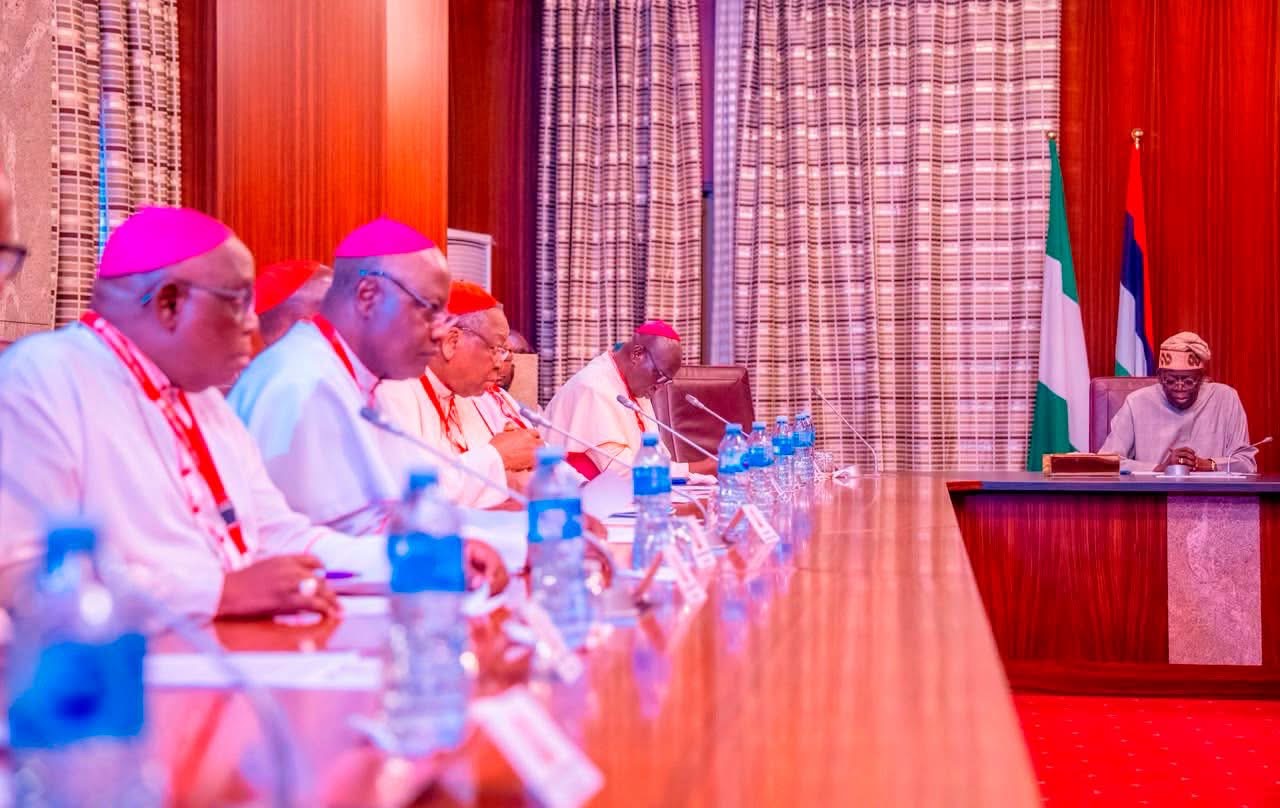
Behind the Rosy Picture: Cardinal Onaiyekan, the Bishops' Visit, and the Crisis of Narrative in Nigeria
Every administration constructs a governing narrative. At its best, that narrative provides direction and inspires public confidence. At its worst, it becomes an echo chamber, one in which dissent is dismissed, inconvenient evidence is filtered out, and political optimism substitutes for empirical reality. History suggests that governments rarely fail because they lack information; they fail because they stop listening.
The legitimacy of leadership rests not on persuasive rhetoric, but on its fidelity to the lived reality of the governed, its connection to the thoughts and well-being of the citizen, and its effective response to their yearnings and aspirations. Without these, it risks governing only those within the circle of power, constructing a false reality for itself rather than engaging the people and the nation it claims to lead.
History teaches that governments rarely collapse because information is unavailable. More often, they falter because the information that reaches the highest offices has been carefully filtered, and leaders begin to hear only what elites or those within the corridors of power present to them rather than what they need to know. Successes are amplified, failures are softened, and criticism is dismissed as politics rather than treated as valuable feedback.
This pattern of filtered information, amplified success, and dismissed criticism from those who bear the cost of failure is precisely what Cardinal John Onaiyekan captured in his Arise TV interview, when he observed that “those hanging around the President are giving him a rosy picture of what the country is, which it is not”. His words expose the false construct of reality imposed on the common Nigerian, a reality from which these leaders remain distant, unwilling to descend from their exalted heights
Political scientists have described this phenomenon as an information bubble, a condition in which decision-makers receive a distorted picture of reality because alternative perspectives are screened out before reaching them. Psychologists identify a related phenomenon known as confirmation bias, the natural tendency to accept evidence that reinforces existing beliefs while discounting information that challenges them.
Together, these forces can create an illusion of progress even when many citizens continue to struggle. Economic and security indicators are seen as having improved only through official reports, and government spokespersons are seen as running and brandishing numbers, yet, in markets, homes, hospitals, schools, and places of worship, ordinary people may be experiencing a very different reality.
The responsibility of leadership is not to choose one narrative over another. It is to understand both and govern with the humility to reconcile them.
Why Cardinal John Onaiyekan's Voice Matters:
His Eminence Cardinal John Onaiyekan occupies a unique place in Nigeria's public life. Over several decades, he has built a reputation that extends well beyond ecclesiastical leadership. He has consistently participated in national conversations on peacebuilding, democratic governance, interfaith dialogue, constitutional development, and social justice. Successive governments, regardless of political affiliation, have regarded him as a thoughtful moral voice whose interventions are typically measured rather than impulsive.
His credibility rests not on political office but on consistency. Throughout Nigeria's democratic journey, he has demonstrated a willingness to challenge governments of different political persuasions whenever he believed national interest demanded it. That record makes it difficult to dismiss his observations as the product of partisan allegiance. His interventions have generally reflected enduring principles rather than changing political fortunes.
Equally important is the manner in which he reaches his conclusions; those familiar with his public ministry often describe a disciplined habit of listening before speaking. His years of engagement with communities across the country, conversations with citizens from different social backgrounds, and close attention to national affairs have shaped an approach rooted more in observation than in political rhetoric.
When such a figure cautions that leaders may be receiving an incomplete picture of the nation's condition, the warning deserves careful examination rather than immediate dismissal. His recent candid comments provided a panoramic review and profound observation that governing effectively requires an accurate understanding of how citizens actually live, think, and say about the situation in the nation; and that no administration benefits when uncomfortable realities are softened before reaching the President's desk. Conversely, no society benefits when constructive criticism is automatically interpreted as political opposition.
Religious institutions such as the Catholic Church, for example, occupy a distinctive position within society. Their networks extend into communities where government presence is often limited, allowing them to observe social realities that rarely appear in policy documents or statistical reports. Their hospitals treat the sick, their schools educate children, and their places of worship regularly hear the anxieties, hopes, and frustrations of ordinary citizens. It is this vantage point that gives weight to a communiqué reviewed and endorsed by more than 82 bishops across every region of Nigeria, backed by the presence of a parish in nearly every corner of the country. Such a document is not the isolated complaint of a few disgruntled voices; it is a collective, nationwide account that government cannot afford to dismiss from within the comfort of its own false glory and borrowed hope
The central question, then, is not whether the communiqué's endorsement by 82 bishops settles the argument, nor whether the Bishops or Cardinal Onaiyekan are right, nor whether every observation withstands scrutiny. Leaders must remember that democracies thrive on disagreement; dissent, robustly expressed, is not a threat to legitimate leadership but a feature of it. The more important question is whether Nigeria's governing institutions remain open enough to perspectives that challenge their own assumptions. That question extends beyond any individual, any administration, or any political party. It speaks to the quality of governance itself. A nation progresses when its leaders possess both the confidence to act decisively and the humility to recognise that truth is rarely confined to the walls of government.
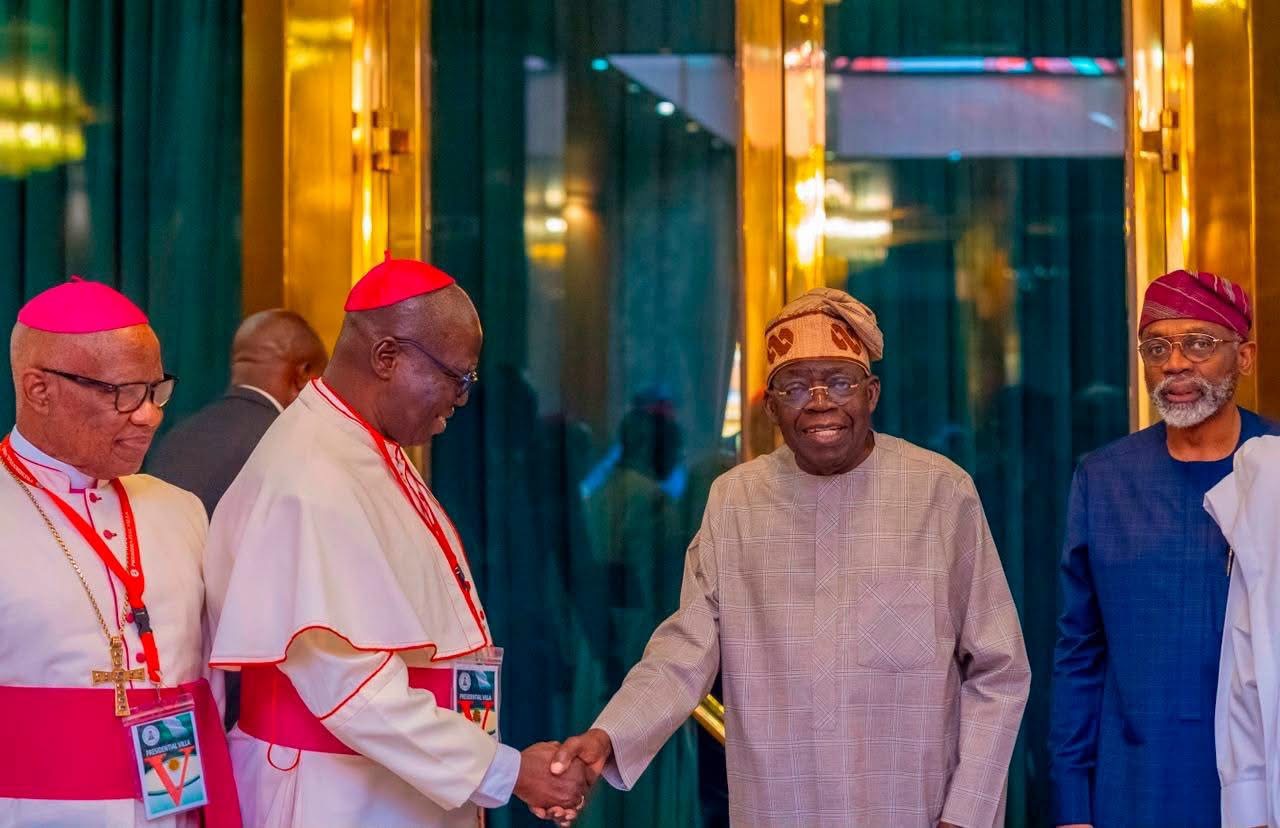
Lessons from the Bishops' Visit and John Cardinal Onaiyekan:
The visit of the Bishops, and Cardinal Onaiyekan's subsequent interview, yielded several key outcomes.
a. The visit and the interview shattered the opaqueness of the glass house of a rosy picture. Cardinal Onaiyekan's vivid description of the body language and gestures of the President and his men was not merely a figure of speech; it was evidence of a governing style, one built on a vague, imagined portrait of the Nigerian people as universally content and thriving, a portrait that has since resonated repeatedly in the speeches of the President's own spokesmen. This collective dismissal of the people's suffering, treated as though it lacked evidence, found its clearest expression when Bayo Onanuga, with characteristic arrogance and pomposity, declared that hunger in the nation was overstated, offering as his proof nothing more than his own household staff and the narrow world visible from within the walls of Aso Villa. Daniel Bwala offered an equally nonchalant and flippant remark, comparing a Nigerian earning sixty thousand naira favourably against Nigerians who had emigrated to the United Kingdom, as though comfort could be measured in naira alone, without reference to what that sum can actually buy.
The World Food Programme has projected that some 34.8 million Nigerians could face crisis-level food insecurity, placing Nigeria among the world's hunger hotspots. These are not figures invented by critics; they are drawn from the nation's own statistics and from the reporting of international agencies. When a government's spokesmen insist that hunger is overstated while the country's own data says otherwise, the dispute is no longer one of differing opinion; it is a government arguing with its own evidence.
The visit provided a deep insight into the obvious aloofness of the government from the people and further corroborated the rosy painting of the tanked economy by the hanging men around the President, in the words of the revered Eminence Onaiyekan. The President, when confronted directly with the reality of national hunger, responded not with a plan but with a history lesson: that hunger existed in Nigeria before he was born, and that Nigerians should let their churches feed them. Each of these statements, taken alone, might be dismissed as an unfortunate turn of phrase. Taken together, Onanuga's denial, Bwala's arithmetic of comfort, and the President's own deflection form a single construct: a government that has convinced itself hardship is exaggerated, survivable, or simply not new. The Bishops' visit mattered precisely because it interrupted that construct with an eyewitness account from outside the circle of power, one the President could not filter before it reached him. It confirmed, in the government's own words and against its own statistics, the very echo chambers this essay has described.
b. Nigerians must brace for a difficult and bitter electioneering season ahead. The President's own words, that "all is fair in politics," are not a neutral observation but a signal that the value of Nigerian lives may again be subordinated to the pursuit of power, just as it has been before. That phrase recalls an older, darker moment in Nigeria's political memory, Muhammadu Buhari's 2012–2015 warning that if the 2011 election were repeated, "the dog and the baboon would all be soaked in blood." When a nation's leaders speak of politics in terms of what is "fair" rather than what is safe, and of hunger as history rather than emergency, the lesson is not comfortable, but the distance between the Villa and the street may be measured not only in policy, but in blood bath. It also reveals, by his own admission, how the President understands elections: not as a contest for legitimate credibility, but simply as a contest to be won, by manipulated perception if necessary, so long as the outcome is victory
c. When governance dissolves into politics, dissent becomes treason. Nigeria must recognize that, in the eyes of this government, governance appears to have given way to the singular pursuit of re-election in 2027. In reviewing well over a dozen statements from the presidential spokesperson, a consistent pattern emerges: each directed and targeted at smearing the character of the Catholic Bishops, and most especially His Eminence John Cardinal Onaiyekan. The vituperation, anger, and coordinated attack that followed, from online bots and fake accounts, but also from real citizens mobilized as the President's foot soldiers, were levelled at an 82-year-old man for speaking the truth to power, a man whose contributions to nation-building exceed those of all these political jobber men combined. When everything becomes politics in the eyes of government, no position, however clear or reasonable, is safe from being recast as an act of enmity against the state.
d. The burden now falls on independent institutions, good-spirited men of character to speak up for the nation. If government has narrowed its tolerance for correction to the point where truth-telling is treated as hostility, the defense of truth and dissent falls, by necessity, to those institutions still capable of independent judgment: the judiciary, the press, religious bodies, and civil society. Their willingness to speak plainly, as the Bishops and John Cardinal Onaiyekan have done, may determine whether Nigeria enters 2027 as a nation still capable of hearing itself, or one further sealed within the false constructs and the self-narrative of doing well even when the lived experiences and the odds speak differently.
Leadership, Listening and Recommendations for Nigeria's Democratic Future:
The debate sparked by Catholic Bishops and John Cardinal Onaiyekan's remarks is ultimately about far more than one interview, one administration, or one political disagreement; it goes to the heart of how Nigeria is governed and how democratic leadership should respond to the realities of a diverse and demanding society.
Governments, however, are not judged solely by economic indicators; they are judged by whether citizens experience the benefits of reform in their daily lives. For a market woman in Aba, a farmer in Benue, a teacher in Kano, or a young entrepreneur in Lagos, governance is measured less by statistical bulletins than by the affordability of food, the availability of jobs, the security of their communities, and the confidence that tomorrow will be better than today. Bridging that gap between policy success and public experience is one of the defining responsibilities of democratic leadership, and it is on this basis that the following recommendations are offered.
1. Institutionalize listening as a function of leadership, not a courtesy, but as a core and functional responsibility of the Government. Presidents receive intelligence briefings, policy memoranda, and economic reports unavailable to the wider public; these are indispensable tools of governance. Equally indispensable, however, are the voices that emerge from outside government: religious leaders, academics, professional associations, civil society organisations, traditional institutions, and ordinary citizens. Government should build formal, recurring channels for these voices to reach the highest levels of decision-making, not merely respond to them when they surface through crisis or controversy
2. Treat criticism as strategic feedback, not political hostility. No government can improve if every dissenting opinion is interpreted as an attack. The most effective leaders cultivate an environment in which uncomfortable questions are examined on their merits, not dismissed because of the identity of the person asking them. Confidence in leadership is demonstrated not by avoiding criticism but by engaging it with evidence, transparency, and humility.
3. Strengthen institutions beyond the personalities who temporarily lead them. Democratic resilience depends on independent bodies trusted to collect credible data, conduct impartial elections, uphold the rule of law, and provide objective oversight. Institutional strength gives citizens confidence that governance is guided by principles rather than personalities, and that accountability will outlast any particular administration.
4. Anchor policymaking in both quantitative data and lived experience. Government should continue to monitor macroeconomic indicators, but must also set up mechanisms for measuring household welfare, community resilience, and public confidence. National surveys, independent research, citizen engagement forums, and regular consultation with stakeholders should be treated as essential instruments of governance, not ceremonial exercises.
5. Practise humility as a discipline of leadership. No administration possesses complete knowledge, and no leader is immune to blind spots. The willingness to revisit assumptions, acknowledge emerging realities, and adjust policy when evidence warrants is not a sign of indecision; it is a hallmark of mature leadership. Nations evolve, circumstances change, and governance succeeds when leaders remain open to learning alongside the people they serve.
Nigeria's democratic journey has been marked by resilience, sacrifice, and the enduring hope of its citizens. Those aspirations place a solemn responsibility on every generation of leaders: not merely to govern, but to govern wisely; not merely to communicate progress, but to ensure that progress is widely experienced; not merely to seek agreement, but to create space for honest counsel.
In conclusion, history rarely remembers governments for how effectively they defended themselves against criticism. It remembers whether they listened when it mattered most; and in the health of a democracy is measured not by the absence of dissent but by the confidence with which it accommodates it. A nation grows stronger when its leaders welcome evidence over assumption, dialogue over defensiveness, and truth over comfort. For Nigeria, that remains both the challenge and the opportunity.
The future will not be secured by optimistic narratives alone, nor by criticism for its own sake. It will be secured by a shared commitment to accountable leadership, strong institutions, and a citizenry whose experiences are heard as clearly as the reports that arrive on the desks of those in power. If that principle guides public leadership, this debate, like the others before it, will have served a purpose beyond politics: it will have strengthened the democratic conversation, and, ultimately, the nation itself.
Victor Imeh Peter Enangama, Ph.D., is a development expert, medical sociologist, and social justice advocate with over 15 years of experience working with international development organisations. Dr. Enangama brings this expertise to bear on the burden of accountability and its implications for development in Nigeria.