40 Dead in France as Europe Heatwave Shatters Temperature Records, Triggers Widespread Disruption
40 Dead in France as Europe Heatwave Shatters Temperature Records, Triggers Widespread Disruption
By Divine Macaulay ·
40 Dead in France as Europe Heatwave Shatters Temperature Records, Triggers Widespread Disruption
PARIS — At least 40 people have died in heatwave-related drowning incidents across France since last Thursday as an unprecedented heatwave sweeping across Western Europe continues to break temperature records, disrupt daily life and raise fresh concerns over the escalating impact of climate change.
French authorities confirmed that the fatalities included a six-year-old child who drowned at a beach in Bègles, Gironde, amid soaring temperatures that have driven millions of people to rivers, lakes and coastal areas in search of relief.
The extreme weather has pushed temperatures to historic highs across the continent. France recorded its hottest day since national temperature records began in 1947, with the country's national temperature indicator — which measures average day and night temperatures across dozens of locations — reaching an unprecedented 30°C on Wednesday.
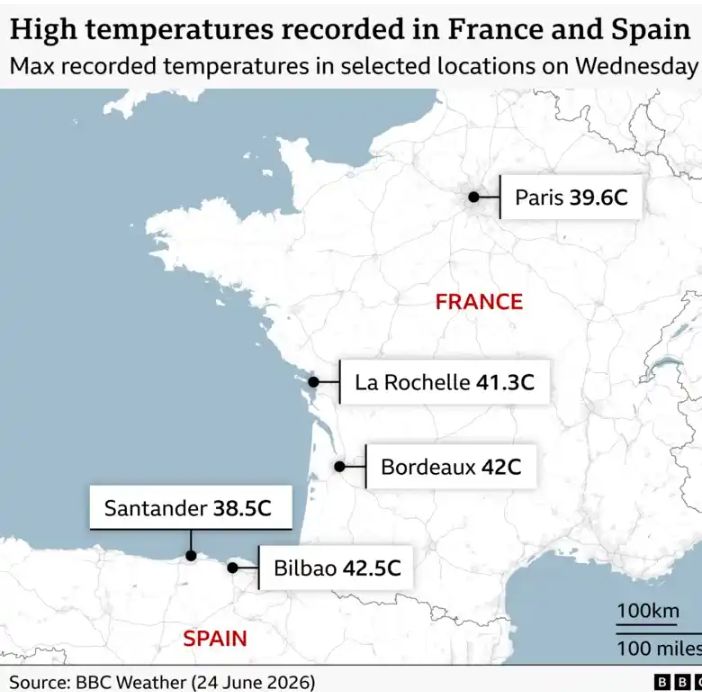
Across large parts of western France, temperatures ranged between 39°C and 43°C, while the Poitou-Charentes-Val de Loire region recorded a scorching 43°C. More than half of France remained under red heat alerts, with tens of thousands of households in western regions experiencing power outages.
In Paris, temperatures approached 41°C, forcing iconic landmarks including the Louvre Museum and the Eiffel Tower to close earlier than usual. Louvre officials said the historic building was "not sufficiently adapted to climate change," underscoring the mounting pressure extreme weather is placing on public infrastructure.
Authorities have also heightened warnings over wildfire risks. More than 150 firefighters were deployed to battle a major forest fire in the Breignon Forest in Maine-et-Loire, which was eventually brought under control overnight.
French Labour Minister Jean-Pierre Farandou acknowledged the growing challenge posed by rising temperatures, warning that the country must adapt to what he described as a new climatic reality.
"We are discovering that France has become a hot country," he said.
Scientists say climate change is intensifying heatwaves across Europe, which is warming at nearly twice the global average rate. The trend has contributed to increasingly severe summer temperatures, mounting pressure on water resources and a growing threat of wildfires across the continent.
The heatwave's impact has extended beyond France. The United Kingdom recorded its hottest June day on record, with temperatures reaching 36.1°C in Gosport, Hampshire, while forecasters warned temperatures could climb as high as 38°C.
Spain also registered its hottest average June temperatures since records began in 1950, with national daily averages exceeding 28°C. Red heat alerts remain in effect across parts of northern Spain, where temperatures could reach 42°C.
Italy has issued 16 red heat alerts, primarily affecting northern and central regions, while Germany, the Netherlands and Belgium are bracing for peak temperatures later this week.
German authorities reported multiple heat-related drowning incidents, including the death of a 26-year-old man in the Danube River near Regensburg, Bavaria. Concerns over drought have also prompted water conservation measures in several German states, while barbecue bans have been imposed in parts of Baden-Württemberg due to heightened fire risks.
Meteorological agencies in the Netherlands and Belgium have likewise issued severe weather alerts, warning that temperatures could rise to between 37°C and 39°C in the coming days.
Although forecasters expect some relief from Friday as temperatures gradually decline in parts of Western Europe, officials warn that the latest heatwave serves as another stark reminder of the continent's increasing vulnerability to extreme weather events.