2027: Middle Belt Group Targets Six million Votes for Tinubu, Shettima
The Pan-Middle Belt Movement for Tinubu/Shettima 2027 has inaugurated its national leadership and commenced grassroots mobilisation across the region, targeting a minimum of six million votes for President Bola Ahmed Tinubu and Vice President Kashim Shettima in the 2027 presidential election.
By ISRAEL BULUS ·
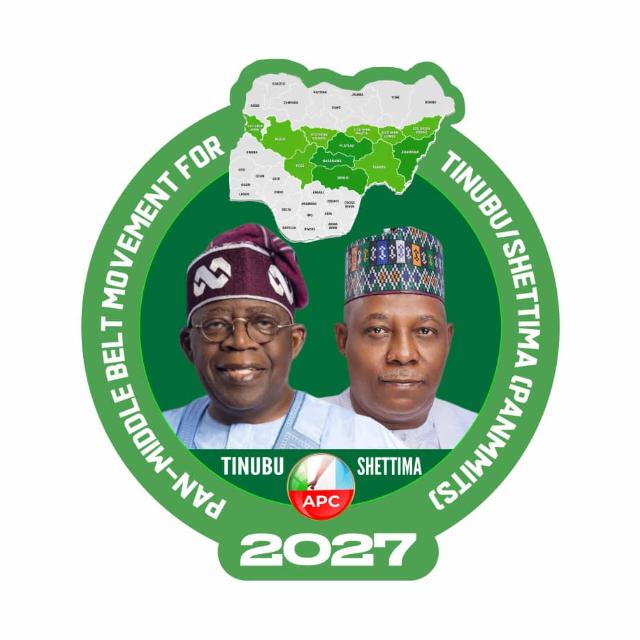
The Pan-Middle Belt Movement for Tinubu/Shettima 2027 has inaugurated its national leadership and commenced grassroots mobilisation across the region, targeting a minimum of six million votes for President Bola Ahmed Tinubu and Vice President Kashim Shettima in the 2027 presidential election.
The in a press statement obtained by The PUNCH Online on Tuesday, said the inauguration which was held in Abuja, brought together stakeholders and representatives from across the Middle Belt and marked the commencement of a coordinated political mobilisation aimed at strengthening grassroots participation and advancing the interests of the region.
The movement was initiated by the Kaduna-South Senator, Barr. Marshall Katung in collaboration with other stakeholders.
Speaking at the event, the Convener, Hon. Comr. Edward John Auta, said the movement was established to provide a platform for people of the Middle Belt to participate meaningfully in the political process while articulating issues affecting the region.
“Our target deliverable is a minimum of six million votes for the President and the Vice President in 2027 from the Middle Belt,” Auta said.
He said the target would not be achieved through a centralised campaign alone, stressing that the movement would take its mobilisation to states, local government areas, wards and communities.
According to Auta, “the real strength of the Middle Belt lies in its people at the grassroots,” adding that the movement would work to build structures capable of translating the region’s population into political influence.
He urged members to engage communities and stakeholders while communicating the policies and programmes of the Tinubu administration to voters.
“We must take this movement to every corner of the Middle Belt. Our structures must be visible and active at the grassroots if we are serious about achieving our six-million-vote target,” he said.
The Patron of the movement, Senior Advocate of Nigeria, Samuel Atung, urged members to overcome what he described as the “minority syndrome” and place collective interests above individual differences.
Atung said the Middle Belt shared a common destiny and should build unity despite differences in ethnicity, religion and political affiliations.
“We must overcome the minority syndrome and understand that our collective interest is greater than our individual differences,” Atung said.
He stressed that the region could secure greater political relevance if its people worked together and approached national politics with a clear understanding of their collective interests.
Atung also urged members to focus on what he described as the opportunities available to the region under the present administration.
He cited federal appointments and development interventions under the Tinubu administration, including infrastructure projects and the establishment of the Federal University of Applied Sciences, Kachia, and Federal Medical Centre, Kafanchan, among other interventions in Southern Kaduna.
The Patron said such interventions should form part of the issues to be presented to the people as the movement engages communities across the region.
The movement’s national leadership has Vice President Kashim Shettima as Grand Patron, while Atung serves as Patron. Auta is the Convener and Hon. Abubakar Isa the Co-Convener.
Other members of the national leadership include Horyen Shaiyen, National Secretary; Ango Bally, Deputy National Secretary; Bomba Dauda, Director of Media and Publicity; Barr. Emmanuel Hundu, Director of Organising; Tanko Rossi Sabo, National Director of Mobilisation; Dr. Ibrahim Habu Ekpo, Director of Contact and Strategy; Dr. Margaret Bija, Director of Welfare; Barr. Simeon Wujat, Legal Adviser; and Hon. Usman Umoru, National Auditor, among others.
The movement resolved that grassroots mobilisation should commence immediately, with state structures expected to establish operational structures down to the local government level.
Members were also directed to engage governors, legislators, traditional rulers, religious leaders, community leaders, youth organisations, professional groups and other stakeholders across the Middle Belt.
The organisation said the engagements would focus on both electoral mobilisation and issues affecting the socio-economic development of the region.
Auta said the movement would seek to ensure that political participation translates into tangible benefits for the people.
He added that the organisation would advocate issues relating to security, infrastructure, education, healthcare, employment and economic development.
The movement also disclosed plans to seek a meeting between its National Steering Committee and Vice President Shettima to formally present its structure and objectives and discuss issues affecting the Middle Belt.
The Director of Media and Publicity, Bomba Dauda, called for a coordinated communication strategy to support the movement’s grassroots activities.
Dauda urged members to provide credible information from their respective communities and ensure that the organisation’s activities were properly communicated to the public.
He said effective communication would be critical to building public confidence and ensuring that the movement’s message reached communities across the region.
The movement also announced plans for a national executives’ retreat to focus on team building, strategic planning and mechanisms for achieving its objectives ahead of the 2027 elections.
The retreat, according to the organisation, would provide an opportunity for its leadership to harmonise strategies, strengthen coordination and develop a roadmap for the grassroots mobilisation campaign.
The movement reaffirmed its commitment to mobilising at least six million votes for Tinubu and Shettima from the Middle Belt in the 2027 presidential election.
It also said it would work to ensure that the region’s political participation translates into meaningful representation, development and greater attention to issues affecting its people.